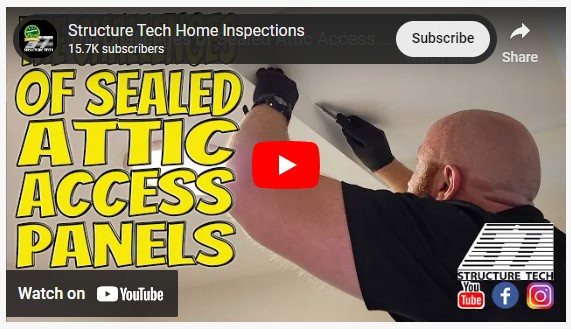
Sealed attic access panels are a bane to home inspectors.

Nothing about home inspections causes more consternation than ‘sealed’ attic access panels; not just for the home inspector, but also for the buyer, the seller, and the real estate agents involved in the sale. Here at Structure Tech, we’ve worked out every angle of attic inspections, and we have some great policies in place to help eliminate problems for both buyers and sellers.
Home seller’s legal responsibility
Most Minnesota home buyers use a standard purchase agreement form. They don’t have to, but most do. This form has a line, all on its own, that says, “Seller will provide access to the attic(s) and crawlspace(s).”

Based on personal experience, I believe most licensed residential real estate salespersons are not aware of this language, and most buyers and sellers aren’t either.
If an attic access panel is sprayed shut, caulked shut, nailed shut, or blocked by stored items, has the seller provided access? Have they fulfilled their contractual obligation? Heck no.
If I were buying a home and the person I was purchasing from had signed an agreement saying they would provide access to the attic, I’d expect the attic to be accessible. Sprayed shut, caulked shut, nailed shut, or blocked with stored items is not accessible.
Structure Tech’s Attic Inspection Policy
Before the inspection: As soon as we schedule a home inspection, we email the listing agent to confirm it and send a very short checklist that needs to be passed along to the seller. We ask for the seller to make the attic accessible, or to leave a note giving us permission to open it if it’s sealed/caulked/painted shut. I secretly suspect that this email gets opened, read, forwarded, opened, read, and followed approximately 1 out of 10,000 times. But that won’t stop us from trying.
At the inspection: We begin every home inspection with a tour of the interior. If the attic access panel appears to be sprayed shut, caulked shut, nailed shut, or similarly obstructed to make access difficult, we ask for permission to open it. We’ll call the listing agent and explain this will technically change the property from its original condition. In most cases, we won’t leave any evidence that we were there, but we can’t guarantee this.
If they give us permission, we open the attic and conduct the inspection as normal. If they don’t give us permission, we don’t go in the attic. Simple and logical, right? We think so. The video above includes a demonstration of me breaking an attic seal to get into the attic.
What the Code says
The 2015 Minnesota Energy Code specifically addresses attic access panels. Section R402.2.4 says “Access doors from conditioned spaces to unconditioned spaces (e.g., attics and crawl spaces) shall be weatherstripped…”
So what does that mean? Weatherstripping is not defined by the energy code. Section R201.4 of the code, Terms not defined, says the following:
Where terms are not defined through the methods authorized by this chapter, the Merriam-Webster Collegiate Dictionary, available at www.m-w.com, shall be considered as providing ordinarily accepted meanings. The dictionary is incorporated by reference, is subject to frequent change, and is available through the Minitex interlibrary loan system.
So let’s head on over to www.m-w.com for the incorporated definition of “weatherstripping”:
A strip of material to cover the joint of a door or window and the sill, casing, or threshold so as to exclude rain, snow, and cold air — called also weather stripping
So does caulk or some other type of sealant cut it? Heck no.
You’d think this would help, but finding a weatherstripped attic access panel on a new construction home is rare. That’s not to say they don’t exist, but it’s certainly the exception.
What to do if you’re a home seller
If you’re selling a home and you sign a purchase agreement from a buyer, know what you’re signing. If the form says you’ll provide access to the attic, please provide access to the attic.
What to do if you’re a home buyer
You should insist that your seller provide access to the attic. This is an extremely important part of a home inspection, even on new construction houses.
It’s quite possible that I’ve written more about attic inspections than any other topic. Here are a few posts specifically related to getting into the attic for inspections.
- Attic access hatches must now be weatherstripped, not sealed
- Dear Home Seller, please let me into your attic
- Attic inspections: opening sealed panels
- Minnesota Home Builder Won’t Allow Attic Inspections, My Two Cents on the Matter
- Magic wand? I’d change the home inspection contingency form
- Who inspected your attic?