When it comes to kitchen hood fans, more properly known as a ducted kitchen range hood, bigger is better. At least that’s what most people think. I won’t discuss this here, but you can listen to me and Tessa discuss it on our podcast: Kitchen Hood Fans: Design, CFMs, Makeup Air, and Myths.
But everyone wants a bigger kitchen fan. And when I say bigger, I mean higher-performing. There’s a lot of stuff that affects the performance of a kitchen hood fan, but today I’m focusing only on the amount of air removed, which is measured in Cubic Feet per Minute, or CFMs. When people say they want a bigger fan, they want more CFMs.
So that brings me to a frequently asked question, which is the title of this blog post, which I tried to make concise. A more common way people ask me goes like this:
“Hey Reuben, I read your blog post on How to calculate makeup air for Minnesota homes and the 300-cfm myth. So my question is, what’s the biggest honking fan I can put in my kitchen before the city inspector makes me install makeup air? Can I pay you to calculate this for me?”

If you’re outside of Minnesota, you probably follow the International Residential Code (IRC). This makes it very easy to figure out. In fact, a little too easy. Section M1503.6 says you need makeup air when you install a fan over 400 CFM and you have feeble* appliances. It doesn’t matter how big the house is or how tight it is… don’t care. This is a dumb, one-size-fits-all “solution” that first showed up in the 2009 IRC and remains today.
But here in Minnesota, we went the other direction. We made it very complicated. And the answer, of course, is right there in my blog post. It just requires some basic algebra!
Ok, fine (sigh). It’s too complicated for the average homeowner, so I made it easy. I had my AI assistant create a spreadsheet to work backward, giving you the biggest possible hood fan without having to install makeup air. This pulls from Tables 501.4.3(1) and 501.4.3(2) of the 2020 Minnesota Mechanical Code. Drumroll please.
Maximum Exhaust Fan Rating Without Makeup Air
You’ll need to save a copy of this for yourself and answer a few questions: year built, square footage, and appliance types. The first two are easy, but the third one may trip people up. For the appliance types, you have four possible options:
Option 1: ONE OR MULTIPLE POWER VENT OR DIRECT VENT APPLIANCES OR NO COMBUSTION APPLIANCES
This typically means you have plastic pipes to vent your furnace, boiler, water heater, whatever. Or you don’t have gas appliances. If you have a gas fireplace with a glass front, this is also considered direct-vent. This category is the most forgiving, allowing for the largest kitchen fan.

Option 2: ONE OR MULTIPLE FAN-ASSISTED APPLIANCES AND POWER VENT OR DIRECT VENT APPLIANCES
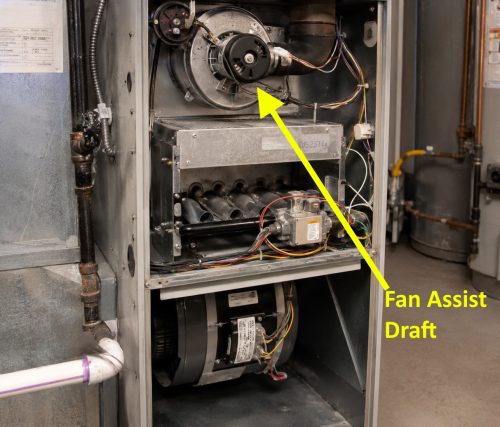
Besides the stuff listed above, you also have one or more appliances with fan-assisted draft. This would be a boiler or a furnace with a metal vent and a little fan that helps get the exhaust gas out of the appliance.
Option 3: ONE ATMOSPHERICALLY VENTED GAS OR OIL APPLIANCE OR ONE SOLID FUEL APPLIANCE
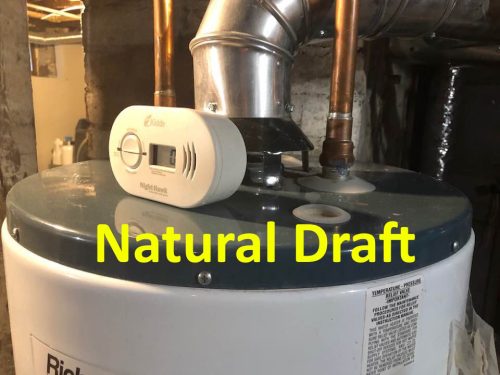
This means you have one feeble appliance in your home. Feeble is my term; I’m referring to an appliance that relies on gravity to get the exhaust gases up and out. If there’s a fight with a fan, it’ll lose every time. The most common version of this is a natural-draft water heater, but it might also be an old furnace or boiler. Also, a solid fuel appliance such as a wood fireplace would count for this category.
Option 4: MULTIPLE APPLIANCES THAT ARE ATMOSPHERICALLY VENTED GAS OR OIL APPLIANCES OR SOLID FUEL APPLIANCES
Same as Option 3, but you have more than one feeble appliance. This is the least forgiving category.
Conclusion
Yes, our formula in Minnesota is complicated, but it’s better. Also, I’m intentionally saving this part for last: you only need to do this calculation in Minnesota if you’re installing a fan over 300 CFM. Smaller fans don’t require this calculation, but that doesn’t mean you shouldn’t do it. This is a smart thing to do for every fan, every home, every time.
If you run this formula and you can’t get the fan you want without makeup air, it’s not the end of the world. You just have to install makeup air. To calculate the size of the makeup air duct you’ll need, check out my other calculator: Makeup Air Calculator with Opening Sizing and Home Age.