
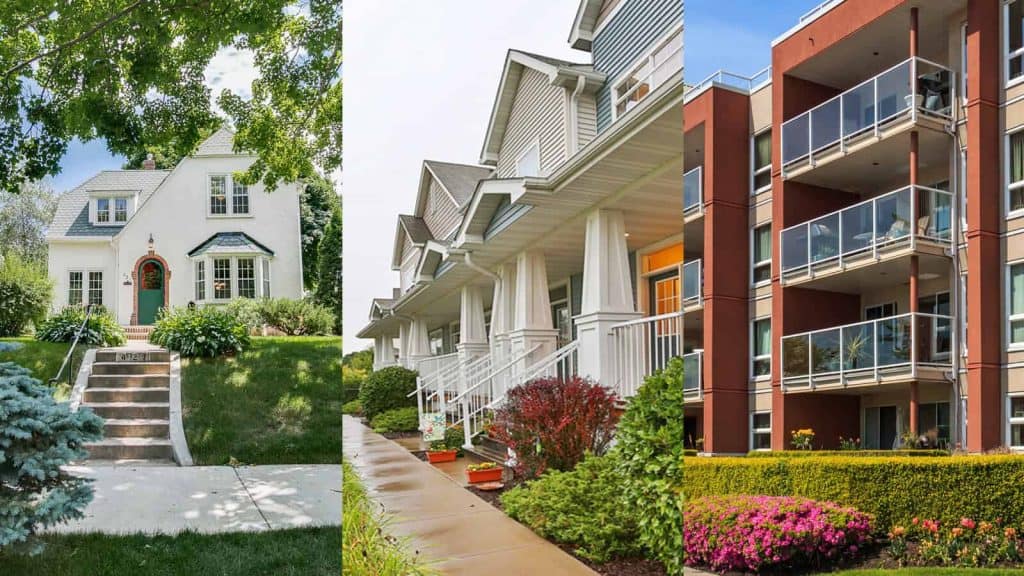
HOUSE
When you buy a house you usually buy a piece of land and all the structures on it, including the house and garage. You are responsible for everything on the property and your only restrictions on what you can do with your property are dictated by the city in which you live. In addition to electricity, gas, water, sewer and trash removal, you are also responsible for hazard insurance, mowing the grass and shoveling the sidewalks and driveway. If the roof or siding need to be replaced or if there are issues with the furnace or water heater you have to deal with it yourself. In a townhouse or condo some of these costs are shared and covered by the monthly association fees.
TOWNHOUSE
When you buy a townhouse you own your unit from the ground to the sky and have your own private entrance, much as with a house. Unless the townhouse is detached, expect to have at least one shared wall and possibly up to shared walls on three sides. This means light could be limited and the direction you face could be more important depending on your natural light preferences. Some townhouses have no private grounds, some do… but all include some shared grounds.
You can usually do as you please inside your unit, but rules about what you can do with your exterior vary from association to association and can include what color you can paint your front door and whether or not you can plant any bushes or flowers. If you want to do something outside normal standards you must request approval from the association board.
CONDO
When you buy a condo you are buying air space in a building and a share in the common areas. It is much like an apartment that you own. Top level units are often preferred because you have no one above you so overhead noise isn’t an issue. It is not uncommon for condos to have restrictions on flooring because of noise… for example, some require carpet and some require a certain percentage of the floors be covered with area rugs.
HOA
Most townhouses and condos are governed by a Home Owners Association, aka HOA. Most HOAs are managed by an outside professional management company, but a few are self-managed by members of the community. They typically have an elected Board of Directors who are the liaison between the management company and the townhouse owners. They all establish their own bylaws and governing rules and regulations.
Both town houses and condos may have rules regarding pets, but condos are usually more restrictive. Many of the newer condos have fewer pet restrictions than older ones.
Town house association fees usually include:
- Snow and lawn care
- Outside maintenance
- Sanitation (trash removal)
- Master insurance policy covering the building structure and exterior (you must secure your own separate HO6 insurance for the interior and your personal property)
- Water/sewer (some town houses include it, but many don’t – condos include it)
Condo fees usually cover all of the above, plus some or all of the following…typically the higher the fees the more that is included:
- Heating (if there is a central heating plant for the whole building)
- Security system (for the building, not individual units)
- Shared amenities, such as a pool, tennis courts, party room, exercise equipment, woodworking shop, car wash (some town houses also have shared amenities)
- Laundry (can be no charge or coin operated)
- Cable television
- Air conditioning (if central for the building, often individual rooftop units for each condo)
- Electricity (pretty unusual, but I have seen it included)
It is important to know whether the association has enough money in reserve to cover ongoing maintenance… if improvements are needed and there isn’t enough held in reserves it may result in a special assessment. Sometimes low association fees aren’t a good thing if they aren’t saving up for future expenses.
Here are some questions you might ask about the association, every one sets it own rules and regulations…
- Are there any pet restrictions?
- Are rentals allowed? If so, any restrictions and what percentage is currently rented?
- What is their long-term repair/replacement/improvement plan? Will there be enough reserves to cover the plan or do they plan to pay for them by special assessments?
- What and when was the last major project, and how was it funded? Any upcoming plans?
- What kind of soundproofing is in between the units?
- Ask for minutes of the board meetings for the last 6 months
- Ask for details of what the homeowner is responsible for and what the association is responsible for
The maximum monthly payment you are approved for when you apply for a mortgage includes association fees. This means that you will qualify for different price ranges for a condo, townhouse or house depending on association costs.
When you make an agreement to buy a property that is governed by an HOA you have 10 days to review association documents to your satisfaction. You can cancel the agreement during that time period if you aren’t comfortable with what you see.

All three forms of ownership are good options…it’s a matter of finding the best fit for you. A house gives you more independence, but also greater responsibility. A condo or town house has the security of more regular expenses and freedom from snow and lawn care, as well as outside maintenance.
Sharlene Hensrud, RE/MAX Results – shensrud@homesmsp.com