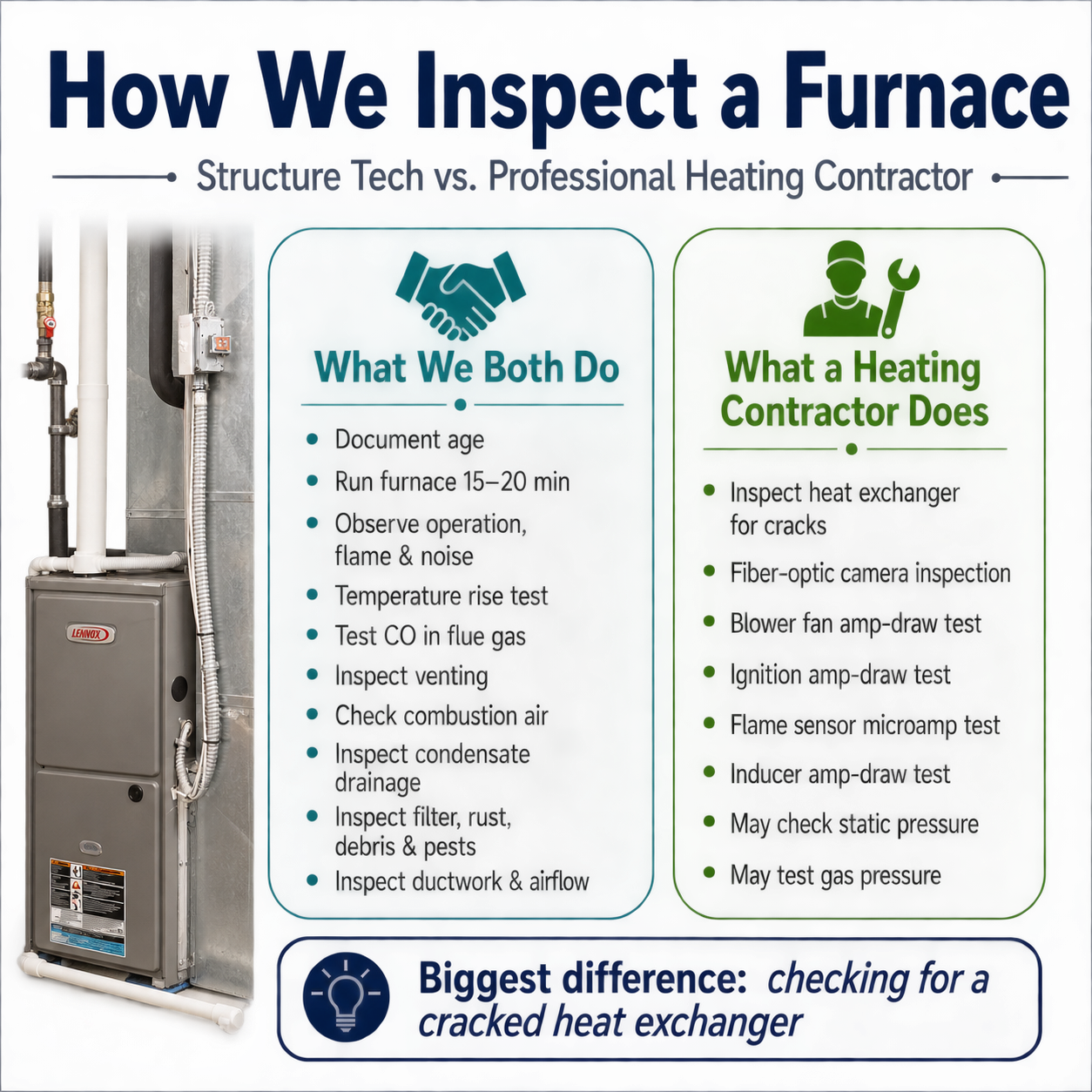
A real estate agent recently asked us, “What’s the difference between what a licensed heating contractor does and what you do for a furnace inspection?” This is a great question. This is what prompted a blog post from earlier this year, where I explained that Minnesota doesn’t license HVAC contractors. But I’m not trying to play semantics here; the question remains the same.
How we inspect a furnace
This is a partial list of the stuff we inspect on a forced-air furnace:
- Determine the age of the appliance and document this.
- Run the furnace. We turn up the temperature at the thermostat high enough for the furnace to run for 15 – 20 minutes. During this time, the furnace should run continuously. It should not turn off unless the thermostat is satisfied.
- Observe the furnace in operation. We make sure it fires up properly, the flame is blue and steady, and listen for funny noises such as squealing motors.
- Perform a temperature rise test. We compare the temperature of the air going into the furnace to the temperature of the air leaving. Every manufacturer has a data plate telling us the acceptable range for this number. If it’s too high, it indicates a problem.
- Test the carbon monoxide level in the flue gas. We use a calibrated combustion analyzer to perform this test to help determine if the appliance is operating improperly. We flag higher levels for servicing. At the high end, anything over 400 parts per million of carbon monoxide (air-free) is unacceptable and must be corrected.
- Inspect the vent. If it’s a category I appliance, we’re checking for proper clearance to combustibles, proper pitch, length, and making sure it’s in good condition. If it vents into a chimney, we also try to ensure there’s a proper liner installed. For a category IV appliance, also known as a high-efficiency furnace, we go through the stuff listed in this blog post: Inspecting High-Efficiency Furnace Venting. There’s a lot to look at.
- Check for combustion air. Older furnaces usually have a combustion air duct dropping down into the room. High-efficiency furnaces usually have a dedicated pipe connected directly to the furnace for combustion air. But not always; it’s fine to install a high-efficiency furnace with one pipe.
- Inspect the drainage system. High-efficiency furnaces require a condensate drain that connects to a floor drain or a condensate pump.
- Inspect the blower compartment and filter. This means removing the cover of the lower compartment of the furnace to inspect for rust, damage, pests, and excessive dirt and debris.
- Inspect the ductwork. We inspect the condition of the ductwork, and look for a heat source in every habitable room. We also verify airflow at every one of these.
- Say mean things about the whole-house humidifier. Ok, that was a joke. I’m not a big fan of humidifiers, but we don’t make a big deal about them unless we see obvious humidity problems in the home.
Again, this isn’t a full list, but this covers the most important stuff we inspect on a furnace.
How an HVAC professional inspects a furnace
In my humble opinion, the best HVAC professionals will do all of those same things I listed above, plus the following:
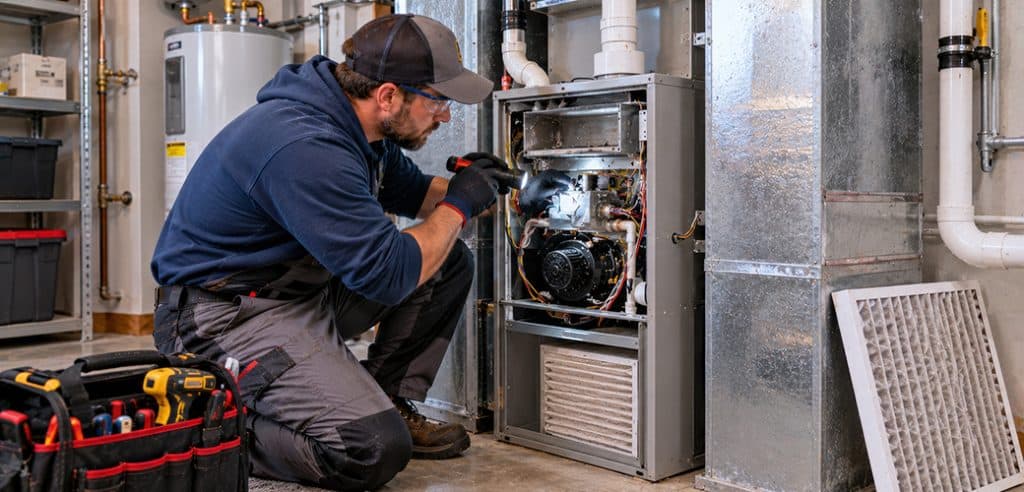
- Inspect the heat exchanger for cracks. This may require dismantling some of the furnace to get access to the heat exchanger, and then using a fiber-optic camera to look inside.
- Perform an amp-draw test on the blower fan. This will help determine whether the blower motor is operating within spec and whether it’s at the end of its life.
- Perform an ignition amp-draw test. This will help to check for premature failure.
- Perform a flame sensor microamp test. Again, to help check for premature failure.
- Perform an inducer amp draw test. I’ll let you guess why.
Some heating contractors may also do static air pressure checks and gas pressure testing. As far as I’m concerned, the most significant difference between what we do and what they do is checking for a cracked heat exchanger. This is a time-consuming inspection, and if a furnace fails this inspection, the heat exchanger must be replaced. This is often cost-prohibitive, so the entire furnace must be replaced.